
Eisenhower's Chance for Peace speech from 1953 is more relevant than ever in 2026
The name Dwight D. Eisenhower doesn't conjure up a lot of emotions to modern citizens of the United States. Like most presidents, Eisenhower did some good things, and he did some bad things. The balance on his account seems like it's close enough to even that his career isn't remarkable as far as presidents go. He doesn't stand out so far on the good side of the ledger as a president like Lincoln. And he doesn't stand out so far on the bad side of the ledger as presidents like Reagan (Iran Contra), or Nixon (Watergate), or even Trump (Epstein, Iran, Russia).
So it might surprise you to learn that Eisenhower was one of the generals who was most responsible for defeating the Nazis. He was the general in charge of the D-Day invasion. He wrangled all of the big personalities involved with that invasion and he managed the greatest military action in human history to defeat a foe that personified evil.
But Eisenhower wasn't a thinking man. He just wasn't. He grew up in a relatively insular Mennonite community, then he was trained to execute orders without question by the US military. He wasn't trained to think, or question authority. He was trained to act, and he did so brilliantly.
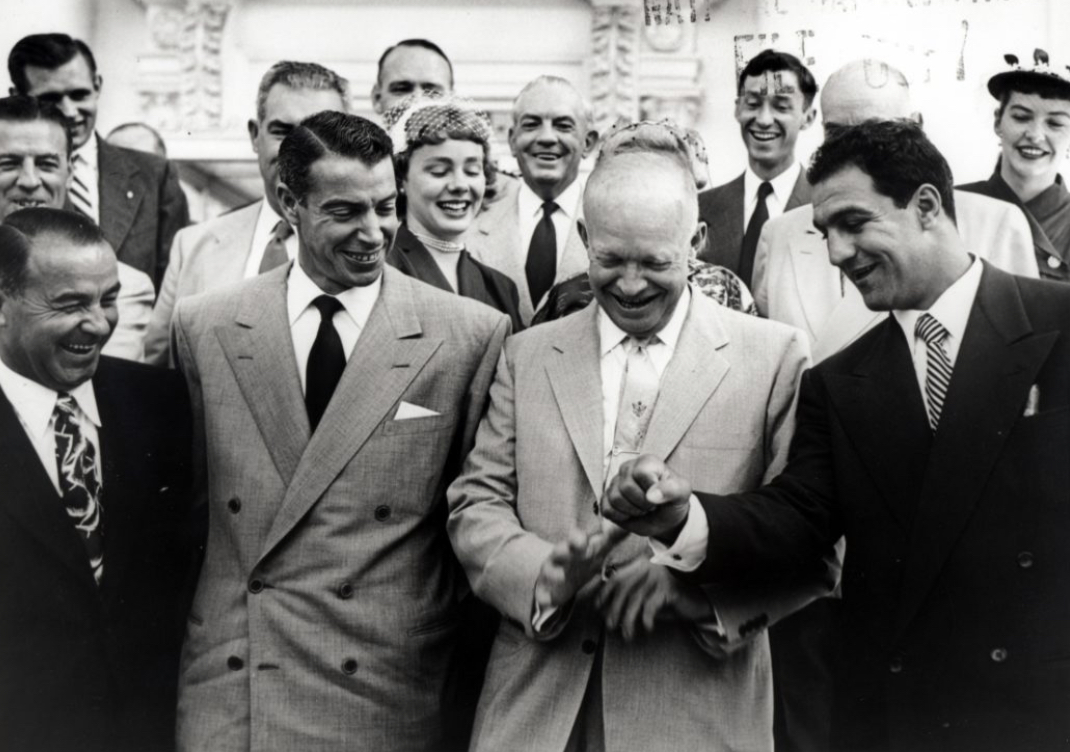
Still, part of his brilliance, and why he is well remembered, is that his wisdom came from the blue collar values of his hardscrabble upbringing. In some ways, his words feel like a twentieth century reformulation of Lincoln's aphorisms, through a person who is less skilled with words.
Recently, I was doing some reading about him when I stumbled upon a speech he gave in 1953, not long after he assumed the presidency. This speech is called the Chance for Peace speech, and as I was reading the text of it, I realized that it is exactly the wisdom we need to guide our country and our planet in 2026.
In 1953, Eisenhower was just at the beginning of the Cold War, but he had no way of knowing that at the time. He saw that moment in time as a final ramping down of the Second World War. Stalin had just died. Eisenhower would quickly bring the Korean War to an end. He saw this as a chance for the world to stop fighting and move away from confrontational militarism.
So he called for peace.
In this spring of 1953 the free world weighs one question above all others: the chance for a just peace for all peoples.To weigh this chance is to summon instantly to mind another recent moment of great decision. It came with that yet more hopeful spring of 1945, bright with the promise of victory and of freedom. The hope of all just men in that moment too was a just and lasting peace.
The 8 years that have passed have seen that hope waver, grow dim, and almost die. And the shadow of fear again has darkly lengthened across the world.
Eisenhower recognized the lost opportunity of the second world war. He recognized the lost opportunity of the wide ranging agreements made between countries in 1945. He wanted to summon that spirit of cooperation again in 1953.
He took an optimistic view of the role of the United States in mid century politics, and an antagonistic view of The Soviet Union.
The way chosen by the United States was plainly marked by a few clear precepts, which govern its conduct in world affairs...The Soviet government held a vastly different vision of the future.
In the world of its design, security was to be found, not in mutual trust and mutual aid but in force: huge armies, subversion, rule of neighbor nations. The goal was power superiority at all cost. Security was to be sought by denying it to all others.
In 2026, this must sound both ironic and appropriate, as The United States maintains the largest military in the world by a huge margin, and both the US and Russia have recently started wars of aggression led by aging leaders with dimming vision.
But Eisenhower, with his life of service in the military, knew that militarism was no end in itself. He knew that conflict led to more conflict. He knew that a country spending money on war could not spend money on peace, and that was the idea behind the most inspired section of the speech.
What can the world, or any nation in it, hope for if no turning is found on this dread road?The worst to be feared and the best to be expected can be simply stated.
The worst is atomic war.
The best would be this: a life of perpetual fear and tension; a burden of arms draining the wealth and the labor of all peoples; a wasting of strength that defies the American system or the Soviet system or any system to achieve true abundance and happiness for the peoples of this earth.
Every gun that is made, every warship launched, every rocket fired signifies, in the final sense, a theft from those who hunger and are not fed, those who are cold and are not clothed. This world in arms is not spending money alone.
It is spending the sweat of its laborers, the genius of its scientists, the hopes of its children.
The cost of one modern heavy bomber is this: a modern brick school in more than 30 cities.
It is two electric power plants, each serving a town of 60,000 population.
It is two fine, fully equipped hospitals. It is some 50 miles of concrete highway.
We pay for a single fighter plane with a half million bushels of wheat.
We pay for a single destroyer with new homes that could have housed more than 8,000 people.
This, I repeat, is the best way of life to be found on the road the world has been taking.
When he tallies up the true cost of war, his vision for our country is almost palpable. This passage alone tells such a vivid story. "This world in arms is not spending money alone. It is spending the sweat of its laborers, the genius of its scientists, the hopes of its children."
This is the passage that resonates the most to me in 2026. When I think about the unilateral invasion of Ukraine or the unilateral bombing of Iran. Trump and Putin are busy spending our work and our lives on their violence.
What really amazes me about this passage is that Eisenhower was essentially calling for less military spending. He was calling for a lower defense budget. This was idealistic at the time, and it seems almost hopelessly optimistic in 2026.
But that doesn't make it wrong.
Perhaps Ike's call for less spending on the military may not have worked out in his favor, but it wasn't misinformed or naive. Nobody in the world knew more about military spending and foreign policy at that moment that Dwight D. Eisenhower. He stood in the unique position to know exactly how war spending was draining America's strength then. He knew that if we kept fighting each other, then we would have no strength to work together on the real problems facing the people of the world.
We seek, throughout Asia as throughout the world, a peace that is true and total.Out of this can grow a still wider task—the achieving of just political settlements for the other serious and specific issues between the free world and the Soviet Union.
None of these issues, great or small, is insoluble—given only the will to respect the rights of all nations.
Eisenhower then made a specific call for disarmament and a slow draw down of military spending by all countries. Eisenhower loved bullet point lists, and he made a list of goals for limiting army sizes, limiting atomic arsenals, and enforcing these limitations.
And in the final lines of the speech, he reiterated the purpose of all of this in a way that doesn't even need to be altered to resonate with the people of 2026.
The purpose of the United States, in stating these proposals, is simple and clear.These proposals spring, without ulterior purpose or political passion, from our calm conviction that the hunger for peace is in the hearts of all peoples—those of Russia and of China no less than of our own country.
They conform to our firm faith that God created men to enjoy, not destroy, the fruits of the earth and of their own toil.
They aspire to this: the lifting, from the backs and from the hearts of men, of their burden of arms and of fears, so that they may find before them a golden age of freedom and of peace.
Sadly, Eisenhower's call for peace fell on deaf ears.
The cynics in The Soviet Union took this speech as nothing more than propaganda. Then, as now, they didn't believe that anyone would truly act "without ulterior purpose."
The people of the US loved the speech, but they didn't appreciate the implications of Ike's words. Then, as now, the people of the United States were too mesmerized by the power of capitalism to pay attention to foreign policy.
The Cold War continued to be hot in places like Vietnam and Afghanistan, even though Ike was able to bring a swift end to the war in Korea.
You can and should read the full text of Ike's speech on Wikimedia.