
Loblolly Pine
Pine trees are dinosaurs. They were born alongside the dinosaurs in the distant eddies of lost time that we call The Jurassic. Their story is epic and unknowable. All we can say about their history for sure, is that they somehow managed to find a way to survive on every continent except Antarctica. They are supreme pragmatists, doing what they must to adapt to any climate and any situation. No matter how much damage humanity does to this planet, the pines will inevitably adapt and survive us.
Yet, even within this resilient genus, Pinus taeda, the Loblolly Pine, distinguishes itself as the king of tenacity, and a quiet titan of the American landscape.
Loblolly is not a word that is heard much in modern English. It’s an antiquated term for a mud hole or a swamp, and that’s the natural setting for Loblolly Pines. Loblolly Pines prefer to grow in the waterlogged, acidic soils of the American South where other species may struggle. Far from being a niche specialist, however, this tolerance for swampy ground has allowed the Loblolly Pine to become the second most common tree in the United States. It drapes the southern states in a vast, evergreen blanket, a testament to its adaptive genius. It is a generalist in the best sense, a tree that saw opportunity in the muck and claimed an empire.
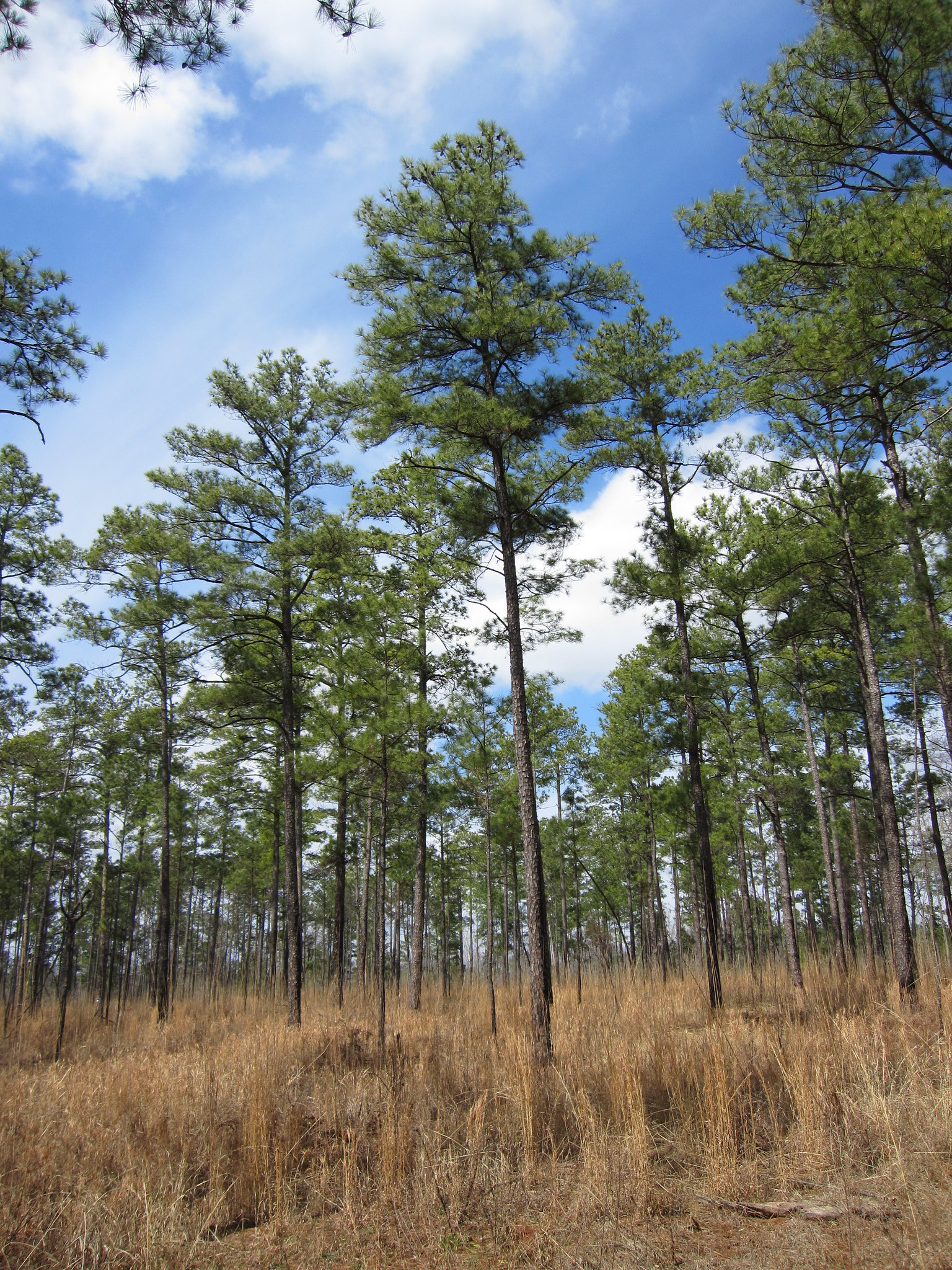
What makes the Loblolly Pine truly fascinating is the duality of its nature: it is both a rugged survivor and a vigorous grower. In the wild, it is a pioneer species, often one of the first trees to recolonize disturbed land, its thick bark providing a defense against the periodic fires that sweep through southern ecosystems. It holds its ground with a quiet defiance. Yet, this same tree is the backbone of the southern timber industry precisely because it is anything but quiet when growing. Shooting upwards at an average of two feet per year, its ambition is relentless. This rapid growth, paired with its straight trunk and strong wood, makes it an ideal tree for the lumber industry.
The Loblolly Pine’s genetic story is also one of epic proportions. In 2014, it became one of the first species to have its entire genome sequenced. Its genome is roughly seven times the size of a human’s, and it held the record for the longest discovered genome until 2018. This vast genetic toolkit is a reflection of its long evolutionary journey, providing the raw material for its remarkable adaptability. It is a living chronicle of survival, a complex script that allows it to be both an ancient relic and a modern workhorse.
The Loblolly Pine is more than just a tree; it is a symbol of persistence, a quiet engine of economy, and a deep-rooted piece of the American story, written in needles, bark, and an unyielding will to grow.